Prophecy in Caricature.
Engineering News—December 21, 1889
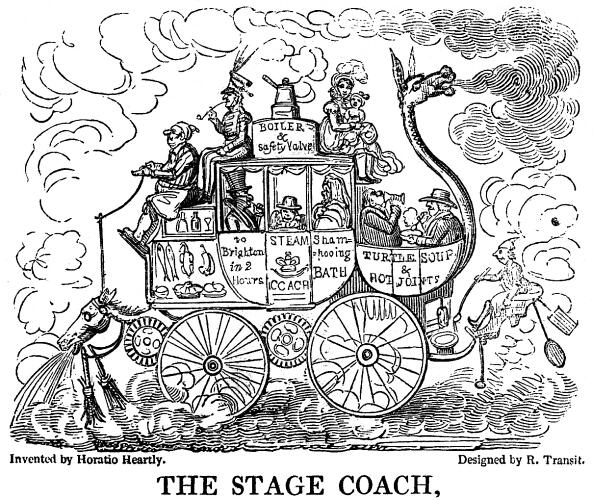 An old print, here reproduced,
comes to us without other title than that given and with no clue
as to its (late of issue, but it is a genuine old print and is
worthy of some study and comment. The date of this caricature
is probably 1825-27, a period antedating the famous trial of locomotives
running on metal rails, and marking a time when the coach was
still the accepted type of vehicle and the general public still
looked upon their highways as the roads of the future; the only
change anticipated was that steam would "somehow" supplant
horses. An old print, here reproduced,
comes to us without other title than that given and with no clue
as to its (late of issue, but it is a genuine old print and is
worthy of some study and comment. The date of this caricature
is probably 1825-27, a period antedating the famous trial of locomotives
running on metal rails, and marking a time when the coach was
still the accepted type of vehicle and the general public still
looked upon their highways as the roads of the future; the only
change anticipated was that steam would "somehow" supplant
horses.
In our issue of Sept. 8, 1888, a caricature of a "steam-buggy"
was shown, issued probably at about the same period as the above.
But this particular cut is chiefly interesting from the fact that
the artist, in attempting to reach the supreme height of absurdity,
builded better than he knew. This was supposed to be a London
and Brighton coach. The distance between the two places is fifty-two
miles. The inscription on one of the panels promises the phenomenal—and
presumedly impossible—speed of "To Brighton in 2 hours."
The locomotive hauls the modern steam coach from London to Brighton
in about one hour.
Studying the outfit further, we find that the prophetic soul
of R. TRANSIT has really inspired him to depict the prototype
of our latest "vestibule railway train" in the conveniences
to be put at the command of the traveling public. The soldier
on the upper seat may be said to be occupying the smoking compartment;
and the stout gentlemen in the "boot" are evidently
enjoying the practical advantages of a modern buffet or dining-car.
The cook is not so securely housed as he is to-day, but if the
inscription on the boot be not false, he is prepared to compete
with his Pullman brother in the character of the good things served
up. And while no especial conveniences for this purpose are shown,
another panel promises "shampooing, bath," in other
words, the latest barber-shop adjunct to the vestibuled train
of to day.
The artist's name, fully set out, is probably RAPID TRANSIT,
and he doubtless believed that in his picture he had added about
all the "impossible" features of fast traveling that
a vivid imagination could suggest. The design is but one example
among many of the inadequate appreciation of the people of the
first quarter of this century of the revolution that was to follow
the introduction of steam as a substitute for the old-time coach-horse.
Antebellum RR
| Contents Page
This page originally appeared on Thomas Ehrenreich's Railroad Extra Website
|