|
AUTOMATIC ATTACHMENT FOR LOCOMOTIVES.
Scientific American—November 20,
1886
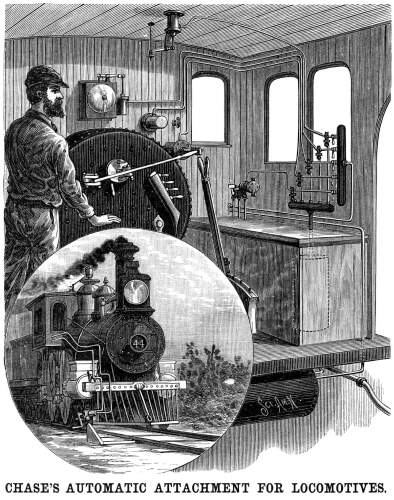 The purpose of
this attachment is to prevent accidents and collisions by a more
effective safeguard than has heretofore been devised. It not only
gives warning of the impending danger to the engineer, but itself
absolutely stops the train. If, for any reason, the engineer should
fail to notice a signal, this invention puts it in the power of
every trainman, switchman, or watchman at any point along the
track to stop the train in time to prevent accident even if the
engineer had for any reason left his engine. The purpose of
this attachment is to prevent accidents and collisions by a more
effective safeguard than has heretofore been devised. It not only
gives warning of the impending danger to the engineer, but itself
absolutely stops the train. If, for any reason, the engineer should
fail to notice a signal, this invention puts it in the power of
every trainman, switchman, or watchman at any point along the
track to stop the train in time to prevent accident even if the
engineer had for any reason left his engine.
Attached to one side of the cow-catcher of the locomotive is
a three-way cock, the lever for operating which projects at one
side, so that an obstruction placed alongside of the track will
operate the cock as the locomotive moves past. The movement of
this cock admits air, obtained from the usual compressed air reservoir
supplying the brakes, to five small cylinders. The shifting of
the piston of one of these cylinders admits air to a pipe for
applying the brakes, the second piston operates the throttle valve,
the third opens the sand valve for sanding the track, the fourth
rings a gong bell placed within the cab, and the fifth opens the
valve of the steam engine. The mechanism for accomplishing these
operations is so simple as to obviate all danger of getting out
of order and to render certain the working of the entire system.
It will be understood that these devices may be so arranged as
to all operate at the same time or singly, as may be desired.
The inventor of this attachment for locomotives, Mr. Norman
F. Chase, of Montrose, N. Y., presents the following advantages
and reasons why it should be extensively adopted: First, the absolute
certainty of preventing accidents and loss of life; second, preventing
destruction of property; and third, economy in first cost and
in use, as all lights can be dispensed with if desired.
Related Page | Contents Page
|