THE JULIEN SYSTEM OF LIGHTING RAILROAD
CARS
Scientific American—May 7, 1887
In the illustrations accompanying this article we show the
application of the electric light to the illumination of cars.
The apparatus consists of incandescent lamps, supplied by storage
batteries of the Julien type. A number of cars, sleeping, parlor,
 and ordinary ones, and even a baggage car,
are now thus lighted, and it is fair to assume an extensive introduction
of the system. The public attention has been so forcibly drawn
to the dangers of kerosene lamps on railroads, that special interest
attaches to the subject of the electric lighting of vehicles of
travel. and ordinary ones, and even a baggage car,
are now thus lighted, and it is fair to assume an extensive introduction
of the system. The public attention has been so forcibly drawn
to the dangers of kerosene lamps on railroads, that special interest
attaches to the subject of the electric lighting of vehicles of
travel.
The installation on different cars varies in the number, character,
and distribution of the lamps. The plant in all the cases we allude
to comprises a storage battery. The battery is of the type manufactured
and supplied by the Julien Electric Co., of this city. This is
carried in a receptacle beneath the longitudinal center of the
body of the car and to one side of it. From it one or more circuits
are carried through the interior of the car. On then the lamps
are arranged in parallel or, as it is frequently called, in multiple
arc. Edison or Weston lamps are used, and suitable switches provided
for turning all or part of the lamps on and off.
The illustrations represent the system as applied to a parlor
car upon the New York Central Railroad. Thirty cells of the Julien
storage battery supply the electricity.
They are charged from an Edison dynamo, driven by a horizontal
engine. Two independent circuits are supplied by it. One is used
directly for lighting purposes in the depot. The other, an independent
connection, is for charging the storage battery. On each circuit
is placed an ampere meter, so that the proper current for one
or the other purpose can be supplied.
The storage battery wires run to the main floor of the building
and terminate at a charging bench, their terminals being springs
fastened down upon the surface or "seat," one at each
extremity. If a cell were placed upon the bench and its proper
terminals connected respectively to the right and left hand springs,
it would be in a position to be charged by the dynamo.
Intermediate springs, connected in pairs, are also attached
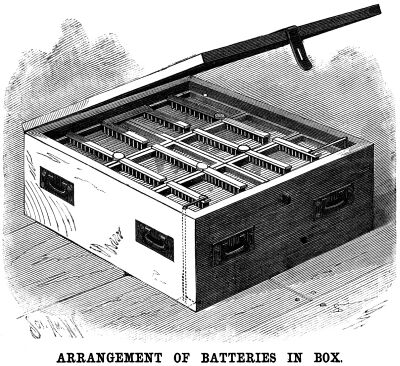
to the bench. The batteries are contained in boxes, six cells
to a box. Upon the bench there is room for six of these cases.
The terminals from the cells in each box, which cells are arranged
in series, 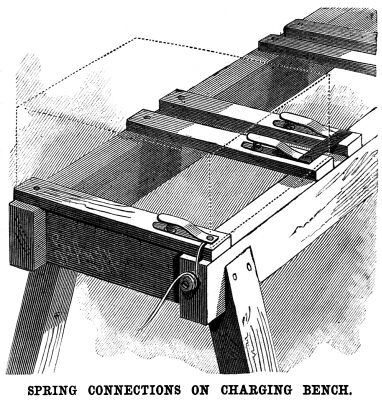 are carried down to two opposite
corners at the front. When the six boxes are in place on the bench,
their terminals press upon the springs, completing the circuit
by means of the series of batteries, throwing thirty-six cells
in series into the portion of the circuit included between the
terminal springs at the extreme ends of the bench. If less than
the six boxes are to be charged, a piece of wire is used to bridge
over the vacant place and connect the adjacent springs. In the
particular car we are describing only five boxes are used, and
the above connection is applied to the charging bench. are carried down to two opposite
corners at the front. When the six boxes are in place on the bench,
their terminals press upon the springs, completing the circuit
by means of the series of batteries, throwing thirty-six cells
in series into the portion of the circuit included between the
terminal springs at the extreme ends of the bench. If less than
the six boxes are to be charged, a piece of wire is used to bridge
over the vacant place and connect the adjacent springs. In the
particular car we are describing only five boxes are used, and
the above connection is applied to the charging bench.
To charge the cells they are ranged in order on this bench
and the current from the dynamo is turned on. It is maintained
at a potential difference of seventy-five volts and at an intensity
of eighteen amperes by the ammeter, which is constantly under
the engineer's eye. Care must be taken to start with sufficient
voltage, as otherwise the battery may discharge through the dynamo.
The current is maintained for seven hours, when the circuit is
thrown open and the batteries are ready for work.
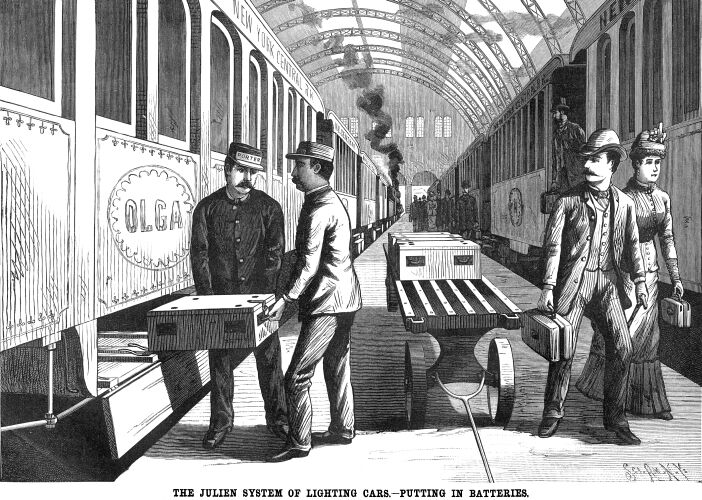
A relay or double set of batteries are provided for the car.
When it reaches the depot, a truck is loaded with the five charged
cells. It is run alongside of the battery compartment, and the
freshly charged boxes are substituted for the exhausted ones.
A corresponding arrangement of springs on the floor of the case
automatically connects the boxes in series. The spent relay battery
is carried on the truck to the charging bench and placed on it
ready for the current. All the work is done by the ordinary depot
employees, no skill or special knowledge being required. The connections
take care of themselves.
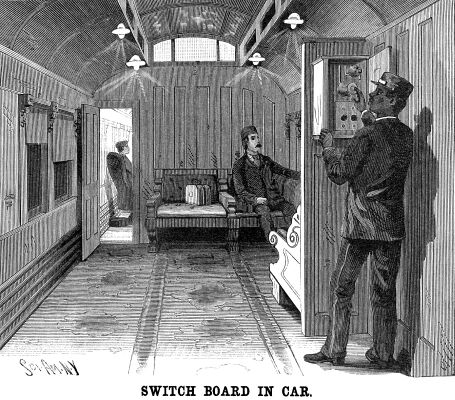
 Within the car the lamps are
arranged in two rows down each side of the car; a total of twenty-four
are employed within. Two lamps are also provided for each platform.
Upon a partition at the saloon end of the car is the switch box.
In it are contained spring switches, by which either the body
of the car, or the toilet rooms alone, or the platform lights
can be thrown into action, or, if desired, all can be supplied
simultaneously. Within the car the lamps are
arranged in two rows down each side of the car; a total of twenty-four
are employed within. Two lamps are also provided for each platform.
Upon a partition at the saloon end of the car is the switch box.
In it are contained spring switches, by which either the body
of the car, or the toilet rooms alone, or the platform lights
can be thrown into action, or, if desired, all can be supplied
simultaneously.
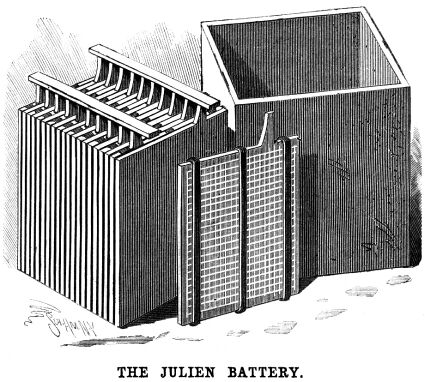
The general construction of the Julien battery is also shown.
The nineteen plates—nine positive and ten negative—are
arranged alternately. Each plate is about one-sixth inch thick.
The metal of which they are composed is an alloy of lead, antimony,
and mercury. They are perforated, so as to represent gratings,
and the openings are filled with a mixture of red lead, litharge,
and mercury. The use of supporting plates of this composition
insures stiffness and prevents buckling, and avoids corrosion
in the charging process. The mercury insures a sort of continuity
between the supporting plate and the active composition. The internal
resistance is about 0.005 ohm.
The normal intensity of current is 35 amperes. The lower the
rate of discharge is kept, the higher efficiency is attained.
On an emergency, it can, without injury, be raised for a short
time to 60 amperes. At starting, each cell gives a difference
of potential 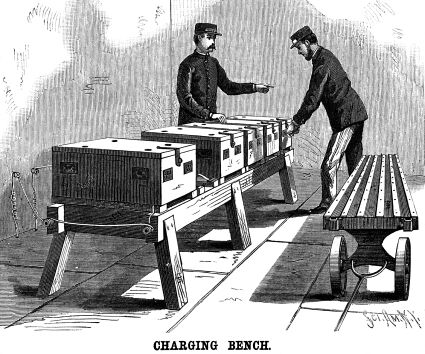 of 2.2 volts, which
may fall to 1.7 volts in the discharge. The plates in a single
cell weigh 27 pounds. For railroad use they are placed in India
rubber cells. Thus established, and filled with acid, the complete
cell weighs 34 pounds. The five boxes represent a total of about
1,000 pounds. of 2.2 volts, which
may fall to 1.7 volts in the discharge. The plates in a single
cell weigh 27 pounds. For railroad use they are placed in India
rubber cells. Thus established, and filled with acid, the complete
cell weighs 34 pounds. The five boxes represent a total of about
1,000 pounds.
To charge these 30 cells, a current of 18 amperes and 75 volts
is required, representing about 1½ electrical horsepower.
Of this current, 82 per cent is claimed to be utilized. In the
charging process, it should be noted that the intensity toward
the end is dropped to 12 amperes, indicating a lower horse power.
Seven hours is required to charge the cells, after which they
are run for four and a half hours, at an intensity of about 16
amperes.
In some cases, the batteries are charged without being removed
from the cars. The wires from the dynamo are connected on the
switch board to the battery wires, and the operation goes on with
all in situ. In such installations only one set of cells
is required.
The storage battery gives a current free from fluctuations,
which is claimed to conduce greatly to the duration of the lamps.
In estimates of expense of maintenance, a duration of two months
with ten hours' daily use is allowed for the lamps. This is found
 to be on the safe side. Thus, on the Boston
and Albany road, in sixty days' running, out of twenty-four lamps,
only three gave out. The other lamps showed no signs of deterioration.
The current from a dynamo is subject to many changes, and it seems
natural that a lamp should run longer on a storage battery circuit. to be on the safe side. Thus, on the Boston
and Albany road, in sixty days' running, out of twenty-four lamps,
only three gave out. The other lamps showed no signs of deterioration.
The current from a dynamo is subject to many changes, and it seems
natural that a lamp should run longer on a storage battery circuit.
The cost is calculated to amount to about 0.6 cent per lamp
per hour. This compares favorably with central station lighting.
The effect of the system as established on the cars is very fine.
When it is remembered that for a few kerosene lamps situated near
the central line of the car roof two lateral rows of twelve 16
C. P. lamps each are substituted, the effect can be realized.
The car is literally almost as bright as day. On one train, all
the cars are thus lighted, from the baggage to the smoking car.
Each one has its own battery and switch board. Great credit is
due to the Julien Electric Company for their method of attacking
this difficult problem, the safe and economical lighting of moving
trains.
Various Apparatus
| Contents Page
|