|
 Some Highways
and Byways of American Travel — 1877 Some Highways
and Byways of American Travel — 1877
A SWITCHBACK EXCURSION.
IT was on a pleasant morning in early spring that I met the
Artist and the Railroad-man at the depot of the North Pennsylvania
Railroad, prepared to take the cars for what the Artist, who is
addicted to punning, called "the Switcherland of America."
Our object was partly business and partly pleasure; in the proportion
of nine parts of the latter to one of the former: indeed, to be
quite honest about it, we were all glad to have an excuse for
a ten days' excursion in a region which promised so much outdoor
entertainment. And the promise was kept. Such another ten days
of rough-and-tumble experience-climbing mountains, falling over
rocks, exploring wild ravines, diving into coal-mines, riding
on every description of conveyance which it has entered into the
mind of man to invent to run on rail—such enormous eating
when we found an inn, and such extravagant sleeping when the day
was done,—I doubt if any of the party had ever experienced
before.
The direct route from Philadelphia to the Lehigh Valley and
the Switchback Railroad is up the North Pennsylvania Road, usually
called the "North Penn," for short. This road carries
you northward on a smooth, well-ballasted track, through a pleasant
farming-country, but shows you few points where you will care
to spend much time in sight-seeing. If you are wise, you will
elect, as we did, to be a through passenger. It terminates at
Bethlehem, and is there met by two roads which run side 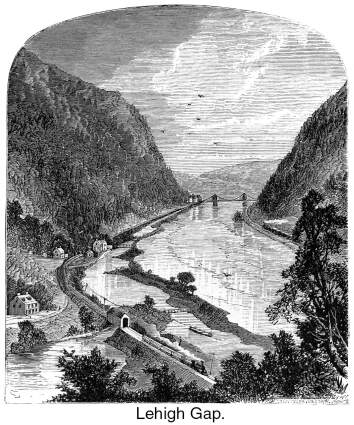 by side up the narrow
valley of the Lehigh, and open to the traveler one of the most
delightful short-trip routes in America. Fifty years ago the valley
was a wilderness, with one narrow wagon-road crawling at the base
of the hills beside a mountain-torrent which defied all attempts
to navigate it. Now, the mountain-walls make room for two railroads
and a canal, but the tawny waters of the stream are nearly as
free as ever. Here and there, indeed, a curb restrains them, and
once an elaborate system of dams and locks tamed the wild river,
and made it from Mauch Chunk to White Haven a succession of deep
and tranquil pools. But one day in 1862 the waters rose in their
might. Every dam was broken, every restraint swept away, and from
White Haven to Mauch Chunk the stream ran free once more. The
memory of that fearful day is still fresh in the minds of the
dwellers in the valley, and the bed of the torrent is still strewn
with the wrecks that went down before its wrath. The Lehigh Company,
who had planned and constructed this magnificent system of slackwater
navigation, looked on in silent dismay and saw the labor of years
vanish in a moment, shook their heads, and proceeded to build
a railroad. After that day's experience they felt as if they could
never trust the river again. by side up the narrow
valley of the Lehigh, and open to the traveler one of the most
delightful short-trip routes in America. Fifty years ago the valley
was a wilderness, with one narrow wagon-road crawling at the base
of the hills beside a mountain-torrent which defied all attempts
to navigate it. Now, the mountain-walls make room for two railroads
and a canal, but the tawny waters of the stream are nearly as
free as ever. Here and there, indeed, a curb restrains them, and
once an elaborate system of dams and locks tamed the wild river,
and made it from Mauch Chunk to White Haven a succession of deep
and tranquil pools. But one day in 1862 the waters rose in their
might. Every dam was broken, every restraint swept away, and from
White Haven to Mauch Chunk the stream ran free once more. The
memory of that fearful day is still fresh in the minds of the
dwellers in the valley, and the bed of the torrent is still strewn
with the wrecks that went down before its wrath. The Lehigh Company,
who had planned and constructed this magnificent system of slackwater
navigation, looked on in silent dismay and saw the labor of years
vanish in a moment, shook their heads, and proceeded to build
a railroad. After that day's experience they felt as if they could
never trust the river again.
I have said that our trip was partly for business and partly for
pleasure. Had it been wholly for pleasure, we should have waited
for the 9:45 train from the North Penn depot which would have
taken us over the Lehigh and Susquehanna Road. As it was, we rose
at an uncomfortably early hour and took the eight o'clock train,
which connects with the Lehigh Valley Road. In either case, however,
the discomfort ends with the traveler's arrival at the depot.
Thence comfortable cars take him to Bethlehem, and from Bethlehem
northward, over either road, through the picturesque Lehigh Gap
and up the mountain-valley.
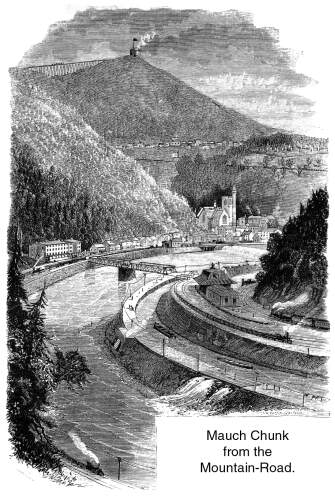 Soon after
leaving Bethlehem the mountains approach the bed of the stream,
and at the Gap fling themselves directly in its path, leaving
it no resource but to go through them; which it has accordingly
done, cleaving the mountain from summit to base in its efforts
to escape. Soon after
leaving Bethlehem the mountains approach the bed of the stream,
and at the Gap fling themselves directly in its path, leaving
it no resource but to go through them; which it has accordingly
done, cleaving the mountain from summit to base in its efforts
to escape.
But it is not until the vicinity of Mauch Chunk is reached
that the peculiar features of the Lehigh Valley appear in perfection.
From here northward it is little better than a canyon enclosed
between high mountain-walls, at whose bases the narrow stream
tumbles and foams, its waters now displaying the rich amber hue
which they have distilled from the roots and plants in the swamps
around their source, now white from their encounter with rock
or fall. Huge rocks hang directly overhead, and threaten to fall
at any moment upon the trains which constantly roll beneath; branches
wave and flowers bloom on the hillside, so close to the track
of the railroad that the passenger can almost reach them without
leaving his seat; here and there a miniature waterfall tumbles
over the brow of a mountain, and glances, a ribbon of foam and
spray, to the river at its foot; and at frequent intervals ravines
cut in the mountain-side present a confusion of rocks and wood
and water to the eye of the traveler as he flashes by. Traced
back a little way from their mouths, these glens often show a
wealth of beauty, a succession of snowy cascades, transparent
pools and romantic nooks which are an ever fresh surprise to the
explorer.
At White Haven both roads leave the valley, cross the intervening
mountain and descend into the Wyoming Valley—a land celebrated
in song and story, a land famous alike for its beauty and its
history. This, by the way, to fill up the gap, as it were, between
our departure from Philadelphia and our arrival at Mauch Chunk.
Here we were to change cars and run up the Nesquehoning Road to
the High Bridge. Half the proposed change was accomplished successfully.
We left the Lehigh Valley train, but while we waited for the Nesquehoning
train to draw up in front of the Mansion House, it came and went,
and we missed it.
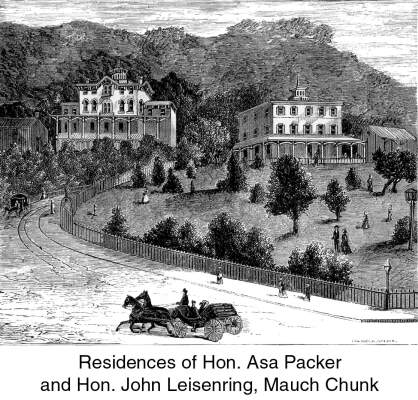 "No matter,"
said the Railroad-man. "We'll catch it at the depot."
Now the depot was a quarter of a mile away, and the train stopped
there about a quarter of a minute. Evidently, there was no time
to be lost. We struck into a lively run, the best man ahead, while
the Mauch Chunkites looked out from four tiers of houses to see
the procession. We made good time in that quarter-mile heat, but
the track was curved and the train had the inside. So we missed
it. It was the second time I had chased a railroad-train, and
I missed the first one. I begin to believe I can't catch one. "No matter,"
said the Railroad-man. "We'll catch it at the depot."
Now the depot was a quarter of a mile away, and the train stopped
there about a quarter of a minute. Evidently, there was no time
to be lost. We struck into a lively run, the best man ahead, while
the Mauch Chunkites looked out from four tiers of houses to see
the procession. We made good time in that quarter-mile heat, but
the track was curved and the train had the inside. So we missed
it. It was the second time I had chased a railroad-train, and
I missed the first one. I begin to believe I can't catch one.
When we arrived at the depot the Artist and I said we had had
enough railroading for one day. We were surprised to find what
an appetite our exercise had developed, and proposed to adjourn
for dinner; but the Railroad-man wouldn't listen to us. He was
bound for the Nesquehoning, train or no train, and he went. In
less than five minutes he had impressed a freight train, loaded
us on it, and we were off. The conductor warned us to "Look
out for sparks. She throws cinders pretty lively, sometimes;"
and we soon began to perceive the value of his admonition. "She"—meaning
the locomotive—uttered a preliminary whistle, and then began
to snort like a porpoise with the whooping-cough, while the atmosphere
suddenly put on an appearance as if a burnt cork factory was being
distributed through it in fine particles. The first rod we traveled
we turned our backs on the engine; the second we turned up our
coat-collars; the third we crawled behind a pile of sills on an
open truck—the same upon which we had at first been seated.
But all would not do. The cinders continued to find us. They flew
into our mouths and ears and eyes and noses, and down our backs
and up under our hats; and wherever they went they burned; and
when we presently struck a heavy grade they came faster than ever.
Human nature could not stand it. "See here," said we,
"this won't do. We shall all look like convalescent smallpox
patients in five minutes more. Let's get out of this."
"Easier said than done. There isn't a covered car on the
train, and we're running too fast to jump off. Besides, we're
bound to see the bridge if we die for it."
"Let's get out on the cow-catcher."
"Lucky thought! But have you ever tried it ?"
"Often. No cinders there, no smoke, no dust; but a pleasant
breeze that will be delightful this warm day; and then you're
always the first to arrive."
"Enough! Lead on!"
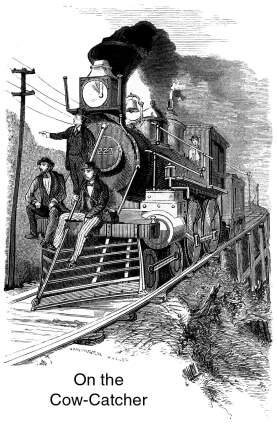 We went forward
and interviewed the engineer. That dignitary was disposed to accommodate
us, but recommended "a bright lookout for cows." We went forward
and interviewed the engineer. That dignitary was disposed to accommodate
us, but recommended "a bright lookout for cows."
"Cows! up here in the woods!"
"Lots of 'em. Run over one every once in a while."
"All right! If we see a cow we'll let you know."
We wanted to show that engineer that we were brave men. We never
had been afraid of cows, and were not going to be now. Besides,
we were half inclined to believe he was hoaxing us. It didn't
look like a good cow-country; and even if it was, and the cows
were thick as grasshoppers, it was his business to steer clear
of them. That's what he was there for.
So we stepped lightly out on the footboard, took a hard grip
on the handrail and cautiously made our way along the iron monster's
side, placed a foot on the steam-chest, swung over on the bumper,
and there we were. It was a glorious ride. The broad platform
on the front of the engine furnished excellent seats, albeit they
were a trifle hard, and the bars of the "pilot," as
railroad-men term the article known to us as the cow-catcher,
seemed made on purpose for footrests. We could feel every throb
of the engine's fiery heart, every gasp of its rapid breathing:
every joint of the rails sounded as we passed like the tramp of
an iron hoof, and the huge machine trembled in every fibre as
it flew along like a living creature urged to its utmost speed.
The air was balmy, the discomforts of the train all behind us,
and before us just enough prospect of danger to add a pleasant
thrill of excitement to the attractions of the ride. The sharp
nose of the "pilot" skimmed along just above the track,
threatening every instant to bury itself in the next stone or
sill that showed its head above the dead level, and tumble us
all into the ditch, but always clearing the obstacle by an inch
or two, and running on without a jar. For pleasant railroad traveling
in warm weather I must recommend the cow-catcher. There's nothing
like it. The only drawback is that it is risky. The cars may run
off the track and smash all to bits, and you may crawl out from
under the ruins perfectly uninjured. I even know an engineer whose
engine took him down an embankment, and literally, and without
any fiction about it, rolled over him twice; and he picked
himself up as sound as you are, got another engine and train and
went ahead, for it was wartime and he was conveying important
orders. But a cow-catcher never does things by halves. You ride
safely or you are killed instantly: one or the other is bound
to happen.
 In our case it
was the former. We rushed along in perfect safety, and though
the predicted cow appeared in due time, and stood defiantly on
the track for a while, she changed her mind before we came within
striking-distance and walked quietly away. In our case it
was the former. We rushed along in perfect safety, and though
the predicted cow appeared in due time, and stood defiantly on
the track for a while, she changed her mind before we came within
striking-distance and walked quietly away.
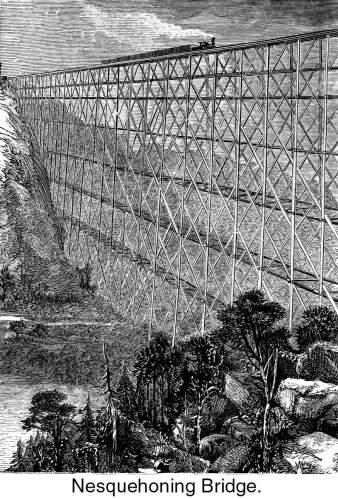
The Nesquehoning bridge has great local celebrity as the highest
bridge in the country. It is flung from one mountain to another
at an elevation of one hundred and sixty-eight feet above the
Little Schuylkill, an insignificant stream flowing through a deep
gorge. Its length is eleven hundred feet, and the view each way
from its platform is one worth going all the way to see. The Railroad-man
inspected it. The Artist made what he called a "rough sketch"
of it—it took him ten minutes, and looked like a perspective
view of a centipede—and then the Catawissa Express came along,
and carried us back to Mauch Chunk and a late dinner.
It was the first day out, and we didn't care how hard we traveled.
We learned better afterward, but now, when the Railroad-man said,
"Shall we go over the Switchback this afternoon?" the
question was carried unanimously in the affirmative.
So he sent out and ordered a "special train." That
sounds magnificent, does it not? We thought so, and we felt like
millionaires as we walked into the Mansion House and ordered our
late dinner.
Dinner over, we walked leisurely to the train—a stroll
which involved the ascent of what, in any other part of the country,
would be called "pretty considerable of a hill." The
Gravity Road nominally runs to the foot of Mount Pisgah, but the
road gives out some time before the gravity does. Ordinary tourists
make the intervening distance in coaches—we aristocrats did
it on foot.
 The special
train was in waiting when we arrived. It consisted of one flat
car, half the size of a billiard-table, with seats for ten, and
no top. A pretty little affair, what there was of it, but it scarcely
came up to our expectations of a special train. The special
train was in waiting when we arrived. It consisted of one flat
car, half the size of a billiard-table, with seats for ten, and
no top. A pretty little affair, what there was of it, but it scarcely
came up to our expectations of a special train.
"This is the superintendent's car. He has loaned it to
us as a special favor. The covered cars will not suit our purpose
as well as this."
Then we took heart again, and got on board, but the Artist
looked suspiciously at the track before us, and asked questions
enough to fill the Shorter Catechism.
"What's that?"
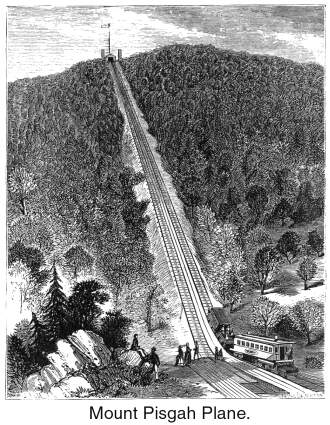
"Mount Pisgah Plane, two thousand three hundred and twenty-two
feet long. You are now two hundred and fifteen feet above the
river, and the river here is five hundred and twenty feet above
tide-water; and when you get to the top of the plane you will
be six hundred and sixty-four feet higher still. That iron band
hauls up the empty cars on their way back to the mines. It is
attached to a 'safety-truck,' which is down in that hole at the
foot of the plane. It goes down there, so that the cars can pass
over and get in front of it. There it goes now. You see it pushes
ten or a dozen cars before it up the plane. The wire rope which
it drags after it runs over a drum-wheel at the foot of the plane—there
it is, that uneasy thing which is always trying to haul a cart-load
of old iron up the hill, and never succeeding—and the other
end of the rope pulls down the safety-truck on the other track.
You see that long arm which projects from the side of the safety-truck
and counts the teeth of that iron thingumbob between the tracks
with such monotonous regularity?
 That's the 'safety'
part of the arrangement. It is expected to hold the train right
there in case the bands happen to break.—Oh, bless you, yes!
They break every now and then. Never broke yet with a passenger-train,
though—we don't load 'em heavy enough—but if they did
the ratchet would hold the cars till the bands were spliced again.
This is the last season for coal-trains. We are sending a good
deal of our coal through the Nesquehoning tunnel now, and pretty
soon shall send it all that way; and then this road will be used
for passenger business exclusively." That's the 'safety'
part of the arrangement. It is expected to hold the train right
there in case the bands happen to break.—Oh, bless you, yes!
They break every now and then. Never broke yet with a passenger-train,
though—we don't load 'em heavy enough—but if they did
the ratchet would hold the cars till the bands were spliced again.
This is the last season for coal-trains. We are sending a good
deal of our coal through the Nesquehoning tunnel now, and pretty
soon shall send it all that way; and then this road will be used
for passenger business exclusively."
This connected discourse is the substance of answers to the
Artist's catechism. The questions would only take up room to no
purpose, and, besides, I like to dispense information in solid
chunks.
By the time this exercise was concluded we were on our way
up the plane. Our ten or twelve hundred pounds were a mere bagatelle
to the big engines accustomed to drawing up fifteen or twenty
tons at a time, and we glided lightly and safely to the top, where
the catechetical instruction was resumed.
"Angle of plane is about twenty degrees. That is Upper
Mauch Chunk on the plateau to the right of the plane, and across
the river you see East Mauch Chunk. Better location than the original
settlement—after you get up to it. No trouble about the drainage,
eh? Old town was started in 1818. First child—living still,
I believe—was Nicholas Brink, born in 1820, and was named
after everybody in the settlement. Had names enough for all his
descendants to the third generation. It's getting late. All aboard!
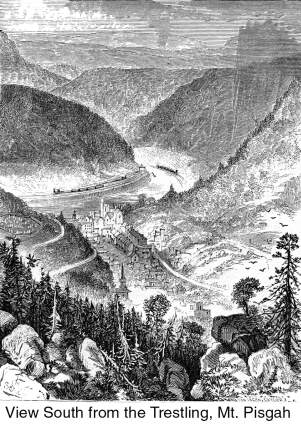
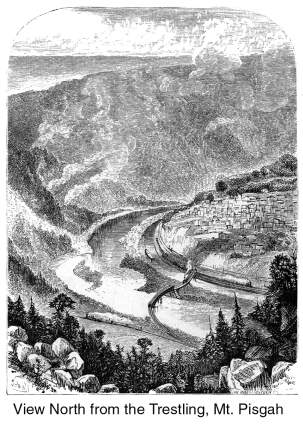
"—and he hurried us away without giving us half enough
time to enjoy the magnificent views from the trestling at the
top of the plane. We must keep moving if we would do the whole
twenty-five miles of Gravity Road between that time and six o'clock,
when the planes would cease working. So we set out without further
delay.
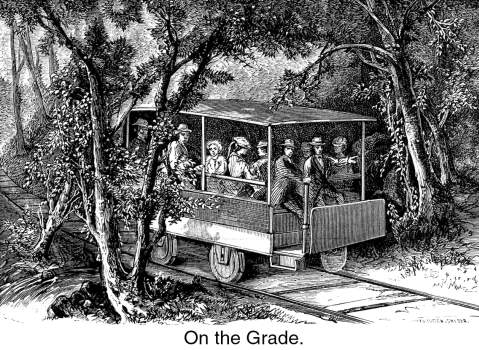
 The Railroad-man
sat in front and held the brake, a lever by which he could slow
or stop the truck at will; but he seldom had the will to do it.
As a general thing, he let it run. The grade from Mount Pisgah
to the foot of Mount Jefferson is sixty feet to the mile—just
enough to propel a light car at a moderate speed. The ride was
through the woods all the way—a pleasant, breezy, cool and
clean run with no danger in it that could not be avoided by a
judicious use of the brake. At Mount Jefferson we were hauled
up another plane, two thousand and seventy feet long, and four
hundred and sixty-two feet high; and one mile from its top we
ran into Summit Hill. The Railroad-man
sat in front and held the brake, a lever by which he could slow
or stop the truck at will; but he seldom had the will to do it.
As a general thing, he let it run. The grade from Mount Pisgah
to the foot of Mount Jefferson is sixty feet to the mile—just
enough to propel a light car at a moderate speed. The ride was
through the woods all the way—a pleasant, breezy, cool and
clean run with no danger in it that could not be avoided by a
judicious use of the brake. At Mount Jefferson we were hauled
up another plane, two thousand and seventy feet long, and four
hundred and sixty-two feet high; and one mile from its top we
ran into Summit Hill.
Then we ran down into Panther Creek Valley, and traversed the
whole course of the Switchback Road, returning late in the evening,
and whizzing down the nine miles between Summit Hill and Mauch
Chunk in nineteen minutes.
Mine host Booth, at the Mansion House, gave us, as he gives
everybody, an excellent supper and splendid beds, and we made
his house our head-quarters during our stay. We sat on the piazza
after supper and smoked cigars and chatted, and watched the fires
on the mountains, which drew bands of flame all around the town,
and counted the long coal-trains that wound among the hills on
either side of the valley; and when we were tired of this we went
to bed, and were lulled to sleep by the plash and drowsy tumult
of the river under our windows.
 We made another
trip over the Switchback a few days after, and as this is not
a consecutive narrative I may as well tell the whole story here,
and have done with it. We made another
trip over the Switchback a few days after, and as this is not
a consecutive narrative I may as well tell the whole story here,
and have done with it.
To begin at the beginning: "The Switchback" is not
a switchback at all, in the technical sense of the word, and has
not been for years. Originally, there were several switchbacks
along the "Gravity Railroad," which is the proper name
for the line under consideration, and they were operated thus:
the cars, running smoothly on a down grade, would reach a point
where they suddenly found themselves going up hill at such a rate
that they were quickly compelled to stop. Then the attraction
of gravitation, constantly drawing them down hill, would cause
them to reverse their direction and run back; but when they again
reached the place where the grade changed, a switch, worked by
a spring, threw them on another track, and they continued their
journey down the mountain in a direction contrary to that in which
they had been running before they came to 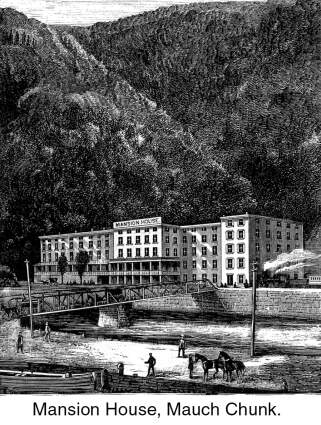 the switchback. The next interruption
would send them in the original direction; and in this zigzag
fashion they accomplished the descent into Panther Creek Valley.
Later and better engineering has changed the switchbacks into
curves, and the descent from Summit Hill to the mines is made
without interruption; but the name, which at first was local and
applied to a particular point, gradually spread until it included
the entire road. the switchback. The next interruption
would send them in the original direction; and in this zigzag
fashion they accomplished the descent into Panther Creek Valley.
Later and better engineering has changed the switchbacks into
curves, and the descent from Summit Hill to the mines is made
without interruption; but the name, which at first was local and
applied to a particular point, gradually spread until it included
the entire road.
And now, having done away with the switchback business, we
will adhere to the proper title, and call our mountain path the
Gravity Road.
This is next to the oldest railroad in the United States. Its
only predecessor was a road three miles long connected with the
Quincy stone-quarries in Massachusetts. That was built in the
fall of I826—this went into operation in May, 1827.
At first the road extended only from Summit Hill to Mauch Chunk.
There was no return track, and consequently no planes, the empty
cars being hauled back to the mines by gangs of mules, which,
in turn, were transported to Mauch Chunk in cars designed expressly
for their use—a ride which they learned to value so much
that no amount of persuasion could induce them to make the journey
on foot. Subsequently, the Panther Creek mines were opened, the
Switchback proper made to reach them, and planes built to assist
gravitation in transporting the cars.
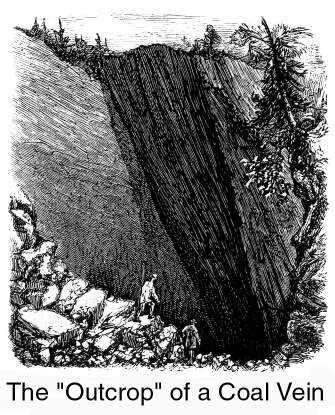
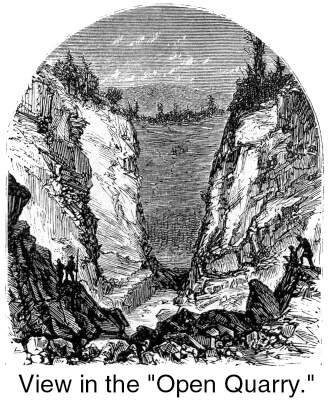 We visited
the spot where, in 1791, Philip Ginther stumbled over a fortune
that was not for him, and where the famous "Open Quarry"
was afterward worked. A part of the wide excavation has been filled
up with the refuse from other workings, but enough remains to
give the visitor an idea of the immense mass of coal originally
deposited here. A better idea of the disposition of the strata
can be gained, however, at an adjoining opening, where the outcrop
of the vein has fallen into the subterranean workings. The solid
mass of coal is here seen just as the last earthquake left it—a
mass of pure, glittering fuel, forty feet or more in thickness
(we did not measure it, for reasons apparent in the illustration),
and running, at a steep pitch, far down into the bowels of the
earth. We visited
the spot where, in 1791, Philip Ginther stumbled over a fortune
that was not for him, and where the famous "Open Quarry"
was afterward worked. A part of the wide excavation has been filled
up with the refuse from other workings, but enough remains to
give the visitor an idea of the immense mass of coal originally
deposited here. A better idea of the disposition of the strata
can be gained, however, at an adjoining opening, where the outcrop
of the vein has fallen into the subterranean workings. The solid
mass of coal is here seen just as the last earthquake left it—a
mass of pure, glittering fuel, forty feet or more in thickness
(we did not measure it, for reasons apparent in the illustration),
and running, at a steep pitch, far down into the bowels of the
earth.
"This fall," said the Railroad-man, "carried
part of the track running into 'No. 2' down with it, and we had
no end of bother with it before we got it filled up again and
the track relaid. That hole you see at the bottom is some six
hundred feet deep, and dumping gravel into it was almost like
trying to fill up the bottomless pit itself."
"Why didn't you go round it?"
"Couldn't. You see those alps of coal-dirt all around
us. We should have had to move those at any rate, and so we just
moved a few of them in here—sent them back where they came
from, as it were—and so at last the thing was done."
 "Does
that thing happen often?" "Does
that thing happen often?"
"What thing?"
"Losing your track suddenly in that fashion. Because,
if it is, we prefer some other road. We're not ready to start
for China by the underground route just yet."
"Don't alarm yourselves. We keep a lookout for breakdowns,
and know just where the ground is weak. You will go through safely
enough this trip, and hereafter, if you're fearful, you can confine
yourselves to the regular passenger-route from Mauch Chunk to
Summit Hill and return. There's no danger there."
So we were comforted, and went on to "No. 2," which
is one of the oldest collieries in the region; and enjoyed the
fine view of Panther Creek Valley which is seen from the end of
its dirt-bank; and looked down the slope, which they told us was
fifteen hundred feet deep (we didn't measure it); and then we
took a look at Summit Hill, which is dirty and uninteresting in
itself, like all mining towns; and then we mounted our truck again
and shot down a fearfully steep grade into Panther Creek Valley.
Here one of the first things we were shown was a burning mine,
but it was a poor affair, recently kindled and on the verge of
being extinguished. The only noticeable thing about it was the
process of putting out the fire by forcing carbonic acid gas into
the mine, and that we did not see. There is another mine at Summit
Hill, which has been burning for thirty years, and is likely to
burn for thirty more: that, now, is something to brag of. A greater
curiosity was the entrance to the Nesquehoning tunnel, four 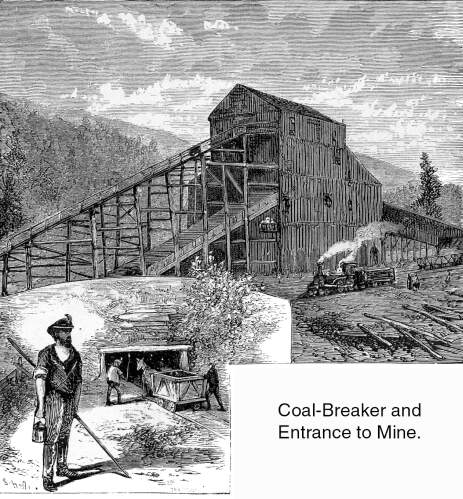 thousand feet long,
a work completed last winter, and one which at one fell swoop
claps an extinguisher on the Gravity Road with all its complicated
machinery. Hereafter, all the coal of this region, instead of
careering wildly over the mountains, drawn by viewless steeds
and enveloped in an atmosphere of romance, will be drawn by a
commonplace locomotive upon a commonplace track through this tunnel
and down the Nesquehoning Road, to Mauch Chunk and a market. But
the Gravity Road will remain for the present, and passenger-trains
will still run on it for the accommodation of those who wish to
enjoy its exhilarating ride, its grand scenery and its many points
of interest. thousand feet long,
a work completed last winter, and one which at one fell swoop
claps an extinguisher on the Gravity Road with all its complicated
machinery. Hereafter, all the coal of this region, instead of
careering wildly over the mountains, drawn by viewless steeds
and enveloped in an atmosphere of romance, will be drawn by a
commonplace locomotive upon a commonplace track through this tunnel
and down the Nesquehoning Road, to Mauch Chunk and a market. But
the Gravity Road will remain for the present, and passenger-trains
will still run on it for the accommodation of those who wish to
enjoy its exhilarating ride, its grand scenery and its many points
of interest.
Before our return home, the Railroad-man proposed that we should
spend a day at Upper Lehigh.
"Where's that?" shouted the chorus.
"Up among the mountains back of White Haven. New place,
just chopped out of the woods: splendid scenery—rocks, ravines,
cascades, good hotel—"
"That'll do! When do we start?"
The Railroad-man named a time for rising, somewhere among "the
wee, sma' hours;" and with the time came Jim to wake us.
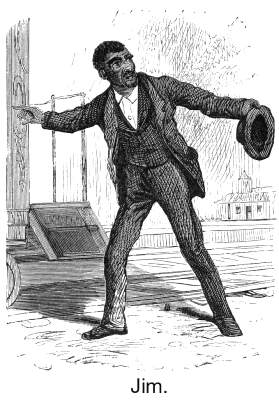 Jim is one
of the institutions of Mauch Chunk. He is a colored citizen, the
porter of the Mansion House, and his duties are those heterogeneous
ones which pertain to porters generally, and to porters in country
hotels particularly. To the traveler entering the town by the
Lehigh and Susquehanna Road the first sight of Mauch Chunk is
Jim standing in front of the hotel and shouting, "Twenty
minutes for dinner! Step right this way, gemmen." And when
the twenty minutes have expired, Jim is seen vibrating like an
ebony shuttlecock between the train and the hotel, gesticulating
excitedly and urging the travelers to an immediate departure.
"Time's up, gemmen! Train's a-goin'. All aboard!" Then
to the conductor," Hi! holdon, dar! Heah's a couple o' ladies
yit." This duty fulfilled, Jim retires into his sanctum,
where he may be seen at any time between-trains, blacking boots
and lecturing on politics to chance hearers. Jim is one
of the institutions of Mauch Chunk. He is a colored citizen, the
porter of the Mansion House, and his duties are those heterogeneous
ones which pertain to porters generally, and to porters in country
hotels particularly. To the traveler entering the town by the
Lehigh and Susquehanna Road the first sight of Mauch Chunk is
Jim standing in front of the hotel and shouting, "Twenty
minutes for dinner! Step right this way, gemmen." And when
the twenty minutes have expired, Jim is seen vibrating like an
ebony shuttlecock between the train and the hotel, gesticulating
excitedly and urging the travelers to an immediate departure.
"Time's up, gemmen! Train's a-goin'. All aboard!" Then
to the conductor," Hi! holdon, dar! Heah's a couple o' ladies
yit." This duty fulfilled, Jim retires into his sanctum,
where he may be seen at any time between-trains, blacking boots
and lecturing on politics to chance hearers.
Well, Jim called us in the early morning—and morning among
the Lehigh Mountains is worth getting up to see. We ate our breakfast,
went to White Haven, changed cars, and rode up the Nescopec Railroad
to Upper Lehigh. The Nescopec Road is nine miles long, and runs
nothing but through trains, by reason of there being no way stations
on the route. At the end of it is a coal-breaker, one of the best
in the anthracite region, shipping five thousand tons of coal
a week; a good hotel—the Railroad-man was right about that;
a row of miners' houses and—woods. We walked about half a
mile along a wood-road, struck into a footpath, followed it a
hundred yards or so, and without warning, walked out on a flat
rock from which we could at first see nothing but fog, up, down
or around. It was a misty morning, but we made out to understand
that we were on the verge of a precipice which fell sheer down
into a tremendous abyss; and when the fog lifted, as it did about
noon, we looked out upon miles and miles of valleys partly cleared,
but principally covered with the primeval forest.
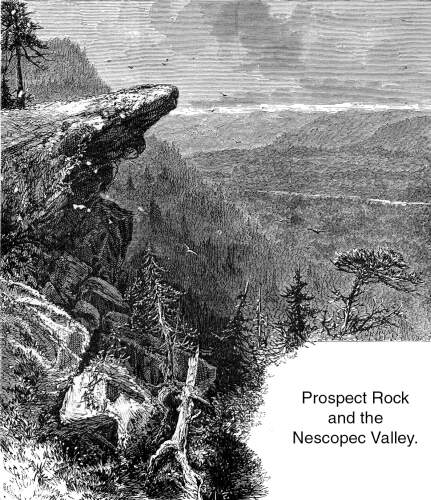 We were on
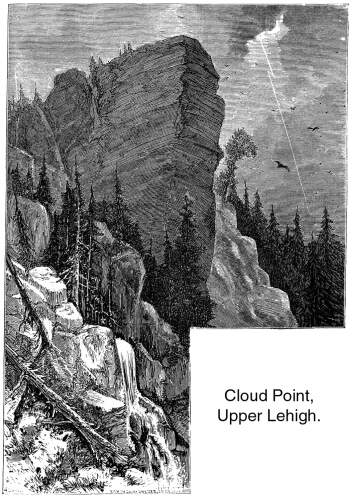
Prospect Rock then. Presently our guide took us, by a round about
way, to Cloud Point, a corresponding projection, on the other
side of the glen, and here a still wider view, another yet the
same, lay before us. We gazed on the beautiful landscape until
we thought we could afford to leave it for a while, and then descended
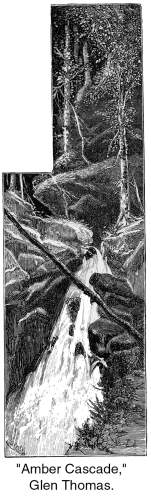
into Glen Thomas, so called in honor of David Thomas, the pioneer
of the iron trade on the Lehigh. It was the first of May, but
we found here miniature glaciers formed by the water falling over
the rocks, the ice three feet and more in thickness, and so solid
that a pistol-ball fired at it pointblank rebounded as from a
rock, while not a hundred yards away May flowers were blooming
in fragrant abundance. We were on
Prospect Rock then. Presently our guide took us, by a round about
way, to Cloud Point, a corresponding projection, on the other
side of the glen, and here a still wider view, another yet the
same, lay before us. We gazed on the beautiful landscape until
we thought we could afford to leave it for a while, and then descended
into Glen Thomas, so called in honor of David Thomas, the pioneer
of the iron trade on the Lehigh. It was the first of May, but
we found here miniature glaciers formed by the water falling over
the rocks, the ice three feet and more in thickness, and so solid
that a pistol-ball fired at it pointblank rebounded as from a
rock, while not a hundred yards away May flowers were blooming
in fragrant abundance.
We spent the whole day in rambling over the rocks and through
the glen, and at evening took the return train to White Haven,
the Artist and the Photographer—who had joined us at Mauch
Chunk—vowing to return soon and often.
Another long-to-be-remembered excursion was to Moore's Ravine,
a wrinkle in the mountain-side two miles, above Mauch Chunk, filled
with tall hemlocks, and at their feet a stream tumbling, in a
continual succession of cascades, from the top of a mountain to
its base. In little more than a quarter of a mile the stream makes
a sheer descent of at least three hundred feet, distributing it
in twenty-one cascades and waterfalls. Two of these, which are
so close together as almost to make one continuous fall and are
named Moore's Falls, are over a hundred feet in total height.
The others are smaller, but no less beautiful, while the limpid
pools of still water among them are by no means the least attractions
of the place.
 But the glen is as wild as
it is picturesque, and to see it requires a good supply of both muscle and perseverance.
It has never been "improved," even to the extent of a footpath, and
the visitor might fancy himself the first that had ever entered it if it were
not for the evidences to the contrary borne by prominent places where a couple
of idiots scrawled their names in white paint. I hope I may be forgiven for
wishing they had tumbled over the highest fall. But the glen is as wild as
it is picturesque, and to see it requires a good supply of both muscle and perseverance.
It has never been "improved," even to the extent of a footpath, and
the visitor might fancy himself the first that had ever entered it if it were
not for the evidences to the contrary borne by prominent places where a couple
of idiots scrawled their names in white paint. I hope I may be forgiven for
wishing they had tumbled over the highest fall.
But the growing length of this article warns me to "cut it short."
I may not tell of our carriage-ride into the Mahoning Valley, with its pleasant
views and drives; nor of mountain-climbing at Mauch Chunk; nor of the flying
visit we paid to Wilkesbarre and Scranton in the beautiful Wyoming Valley; nor
of the day we spent in the pleasant Moravian town of Bethlehem, where we put
up at an ancient hostelrie which was called the "Sun Tavern" a hundred
and odd years ago, and which, under the more modern title of the "Sun Hotel,"
is now, as it was then, one of the best inns in the interior of the State. All
these things must remain untold, but the reader can enjoy them all for himself
at small cost of time or money. He can see the Lehigh Valley, Switchback and
all, in a single day, returning to Philadelphia the same evening, or he can
spend a whole summer in exploring its woods and mountains.
His best plan, however, for a short trip, is to leave Philadelphia or New York
on one of the early trains, timing himself so that he can be at the Mansion
House, Mauch Chunk, in time for dinner. This is the best hotel in the valley
above Allentown, and for that reason he will do well to make it his stopping-place
for the night. After dinner he will have plenty of time to go over the Gravity
Road and return in time for supper. Next morning an early train will take him
to White Haven, where he can change cars and run up the 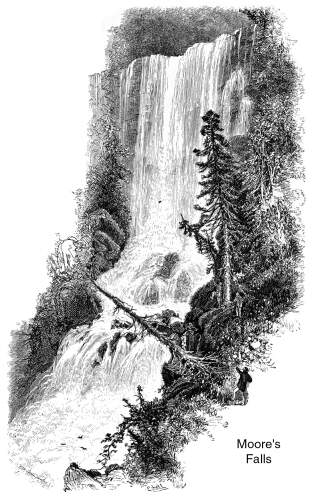 Nescopec
Road to Upper Lehigh, which he will reach about noon. Here he will have ample
time to dine and explore Glen Thomas, but not to see all the fine views from
this singular mountain-top if he would return by the afternoon train. This train
makes connections for both Philadelphia and New York, either of which can be
reached the same evening; but a third day can be profitably spent at Upper Lehigh,
and part of a fourth in exploring Moore's Ravine—to me one of the greatest
attractions about Mauch Chunk, but, unfortunately, accessible from that place
only on foot. It demands a hard walk and a hard climb, but offers in return
a scene of wild and rugged magnificence which in all my mountain-climbing I
have never seen excelled. Nescopec
Road to Upper Lehigh, which he will reach about noon. Here he will have ample
time to dine and explore Glen Thomas, but not to see all the fine views from
this singular mountain-top if he would return by the afternoon train. This train
makes connections for both Philadelphia and New York, either of which can be
reached the same evening; but a third day can be profitably spent at Upper Lehigh,
and part of a fourth in exploring Moore's Ravine—to me one of the greatest
attractions about Mauch Chunk, but, unfortunately, accessible from that place
only on foot. It demands a hard walk and a hard climb, but offers in return
a scene of wild and rugged magnificence which in all my mountain-climbing I
have never seen excelled.
 Stories
Page | Contents Page Stories
Page | Contents Page
|