|
||||||
  
 | ||||||

|
FATAL DISASTER ON THE HUDSON RIVER
RAILROAD.
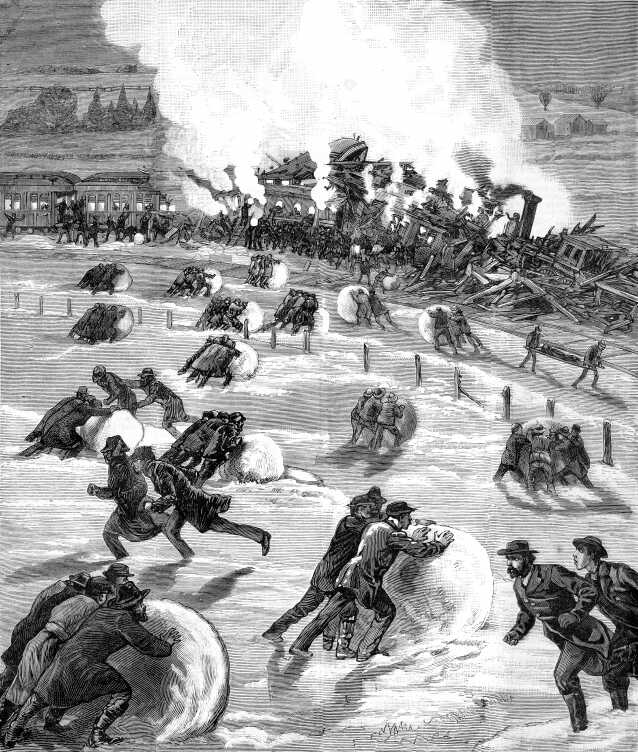
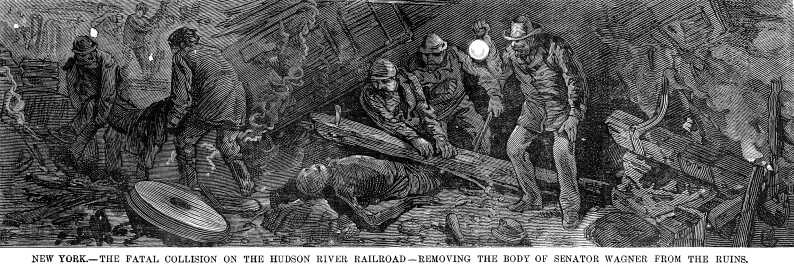
On the train were ten State Senators and twenty-six Assemblymen returning from the capital, but of these only Senator Wagner is known to have been lost. The engine of the Tarrytown train ran under the platform into the car and drove the Idlewild into the Empire with such terrific force as to render it necessary to cut it out. The stoves and lamps in the parlor cars were upset and ignited the woodwork and upholstery. The passengers were jammed between the seats and sides of the car and held while the flames rolled around and enveloped them. Of the twelve passengers in the Idlewild, nine are dead and one has been taken in an ambulance to the Ninety-ninth Street hospital, probably fatally injured. Another passenger, Miss Mary Daniels, aged twenty-five years, of the Sherwood House, New York City, who was returning from a visit to Vermont, is badly scalded about the arms and breast, and is lying at the hotel near the scene of the accident. Oliver B. Keeley, a stove manufacturer, of Spring City, Pa., had his right arm burned to a crisp, and was also burned about the body; he was taken out alive by Detective Dakin, but died at midnight at the hotel. Four bodies, burned beyond recognition, were taken to the Kingsbridge Police Station, one being that of a woman, and five were placed in a room of the hotel, one of which is supposed to be a Mr. Pringle, of Philadelphia. A number of people living in the neighborhood of Spuyten Duyvil Creek flocked to the scene, provided with axes, buckets, etc., and were indefatigable in their exertions to save life. They rushed into the midst of the flames, pouring water and showering heaps of snow in every direction where there was any chance of doing good, but more especially on the rear of the last car whence the screams had been heard. Hundreds of hands were engaged in rolling up big balls of snow. They were passed over the fence to those who, braving the heat, ran alongside the fiery piles and tossed them through the windows to be licked up by the flames. Ladders were procured and efforts made to punch holes through the car-panels. Never did men work with more desperate energy than these Spuyten Duyvil and Kingsbridge villagers. The workmen of the Spuyten Duyvil Rolling Mill turned out in full force to assist in the now fruitless attempt to save life. The cars burned brightly until the last vestige of wood was destroyed. The road was completely blockaded, but at one o'clock a wrecking-train arrived from New York in charge of Superintendent Toucey and commenced to clear the track.
In 1870 Mr. Wagner was elected to the Assembly as a Republican, by a majority of 200. In the following year he was nominated to represent the Fifteenth District, in the State Senate, and was elected by 3,222 majority. At the end of that term he was returned to the Senate without opposition, and in 1875 he was re-elected by a majority of 2,623. In 1877,1879 and 1881 he was also re-elected. Mr. Wagner was a delegate to the Chicago Convention in 1880, and was one of the seventeen New York delegates who opposed General Grant's third-term aspirations, and were instrumental in securing the nomination of General Garfield.
Railroad Accidents | Contents Page
This page originally appeared on Thomas Ehrenreich's Railroad Extra Website
|
|||||
 |
|
|||||