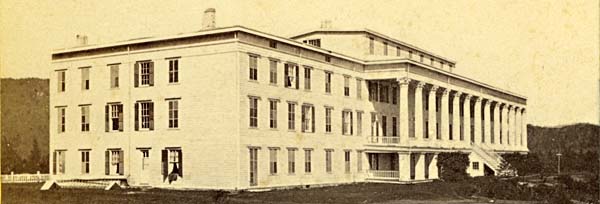
In 1823 a group of Catskill merchants formed the Catskill Mountain Association, for the purpose of building a hotel on South Mountain, on a flat area known as the Pine Orchard. The site was perfect for a hotel, with sweeping views of the Hudson valley, and two lakes behind it providing water and recreation. The Mountain House was built in fall and winter of 1823, and the hotel was opened in the summer of 1824. Click here for an account of a visit to the Mountain House in 1826.

In 1839, Charles Beach, son of Erastus Beach, who owned the stage coach service from Catskill to the Mountain House, leased the hotel from the Association, and in 1845 purchased it outright. During this period, Beach substantially rebuilt the Mountain House, changing the Federalist design into the neo-classical structure that became famous. Under Beach's ownership, the Mountain House dominated tourism in the Catskills. It was not until the 1880's that hotels were built to rival it in size and grandeur. The Kaaterskill Hotel, the Grand Hotel in Highmount, and the expanded Laurel House, plus the smaller hotels that sprang up everywhere, all competed with Mountain House for guests.

One advantage other hotels had was ease of access. Most were close to rail stations, where the Mountain House was accessed by a day long stage ride. In 1892, the Mountain House built the Otis Elevating Railway to bring guests up the 1630' escarpment from Palenville. But the railway was expensive to operate and maintain, and was sold for scrap in 1918, the same year the Catskill Mountain railroad was scrapped. Charles Beach had died in 1902, and over the next 16 years, so did his sons. The end of the Beach's control of the Mountain House coincided with dramatic changes in the Catskills. No longer did New York's elite come to the Catskills. Now it was the middle classes that came, and they preferred the smaller, less expensive hotels. The Mountain House hung on until the start of World War II, but the season of 1941 would be its last. Though the owner, Milo Claude Moseman, was devoted, perhaps obsessed, with saving the hotel, in the end he was unsuccessful. In 1962 the State of New York acquired the property, and the hotel, severely damaged by weather, years of neglect and a misguided attempt to renovate the hotel in 1952-1953, was burned by the New York State DEC on Jan. 25, 1963.

Facts and dates are from Roland Van Zandt's "The Catskill Mountain House"

click on the images below for a larger view

"View of the Catskill Mountain House, NY" by Thomas Cole, c. 1828

"View of the Catskill Mountain House, NY" by Thomas Cole, c. 1828, Engraving by Fenner, Sears & Co. and published in "History and Topography of the United States" London, 1830.

"View From The Mountain House", W.H. Bartlett 1836

"View From The Mountain House", W.H. Bartlett 1836, engraving by R. Branford, published in "American Scenery", London 1838.

"The Two Lakes On The Catskills", W.H. Bartlett 1836

"The Two Lakes On The Catskills", W.H. Bartlett 1836, engraving by J.C. Bentley, published in "American Scenery", London 1838.

Engravings by Thomas Nast from Harper's Weekly, July 21,1866

Engraving from International Monthly, August 1,1851

Engravings by Thomas Nast from Harper's Weekly, July 21,1866

Engravings by Thomas Nast from Harper's Weekly, July 21,1866

he Mountain House from the turn in the carriage road

The Mountain House from the turn in the carriage road, hand colored engraving by Washington Friend, 1865

West entrance to the Mountain House

Loeffler cabinet card of the west entrance to the Mountain House

Catskill Mountain House

Classic postcard view of the Catskill Mountain House.

1897 Loeffler Photograph of the Mountain House Piazza

1897 Loeffler Photograph of the Mountain House Piazza

The front walk along the escarpment

The front walk along the escarpment

Guests admiring the famous view of the Hudson River Valley

Guests admiring the famous view of the Hudson River Valley

"Interior of Catskill Mountain House Ball Room"

"Interior of Catskill Mountain House Ball Room"

From 1920 brochure

"Interior of Catskill Mountain House Ball Room"

"Interior of Catskill Mountain House Ball Room"

From 1920 brochure

West view from Catskill Mountain House

"West view from the Catskill Mountain House"

From 1920 brochure

New Club House, Bowling Alleys, Billiards

"New club house, bowling alley, billiards"

From 1920 brochure

Searchlight playing tag with a steamer on the Hudson River

Searchlight playing tag with a steamer on the Hudson River

The Mountain House, 1953, waiting for the end

The Mountain House, 1953, waiting for the end

Tourists walking in front of the once famous Mountain House.

Tourists walking in front of the once famous Mountain House.

The front steps, showing the bracing put in place to support the piazza roof.

The front steps, showing the bracing put in place to support the piazza roof.

The south wing during demolition.

The south wing during demolition.

The West Entrance

The west entrance. On the left is where the north wing stood for a hundred years, on the right, the south wing is being demolished.


Catskill Mountain House Book

The Catskill Mountain House by Roland Van Zandt

416 pp. Black Dome Press

Captures the birth, glory, and fiery death of America's premier mountain resort. Best known for inspiring the Hudson River School of painting, for 140 years the Catskill Mountain House stood on a rock shelf above the Hudson Valley and facing the River.


Images are from the collection of Timothy J. Mallery.

The Catskill Archive website and all contents, unless otherwise specified, are ©2002 Timothy J. Mallery.